
For three years the stock market has run on one engine: the data center buildout.
Since ChatGPT launched in Nov '22, AI-linked stocks were roughly 75% of the S&P 500's gains and most of its earnings growth (78% in 2024, 64% in 2025) (link).[1]
The economy felt it too: AI-related investment was ~39% of US GDP growth through September 2025, more than consumer spending (link).[1]
So when Democrats swept Congress and the governor races in Texas, Georgia, New Mexico and Nevada, where that steel and power is going in, the market read it as a threat to the trade holding up the house (link).[2]
And what a day. SPY fell 4.4% and QQQ 6.5%, the worst session since the April 2025 tariff shock and, by our math, a five-standard-deviation move.
Here is what the headlines skip: days like this have historically been better entry points than exits. Since 2006, SPY has had 15 one-day drops of 4% or more; a year later it was higher 93% of the time, with a median gain of 22.8%. The next month is closer to a coin flip.
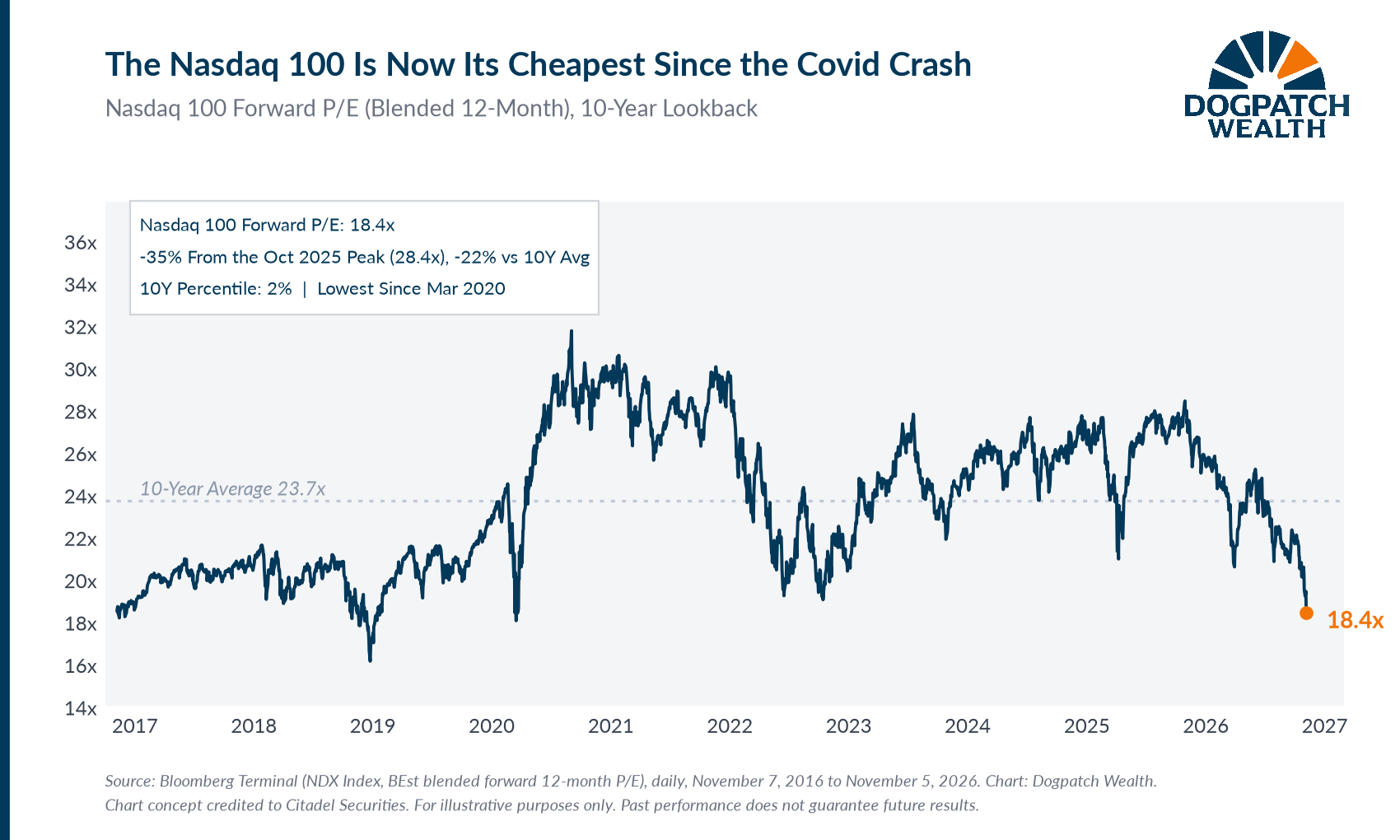
The Nasdaq 100 has also risen in the year after every midterm since 1986 (link),[6] and its forward P/E has reset to 18.4x, the lowest since the Covid crash (link).[7]
Flushes like this clear out leverage and hand patient money better prices. As Goldman's trader put it, "It is always darkest before dawn" (link).[3]
Goldman's bear case is that delays become cancellations: by 2028 there may not be enough data center shells (land, power, buildings) for all the chips, leaving capacity growth closer to flat than the 30%+ priced in (link).[3]
Texas shows the stakes. Bloomberg Intelligence projects the new electoral landscape could reshape policy for almost 45% of US capacity under construction, including Texas, home to 24.5% of the total, whose governor-elect campaigned on a moratorium (link).[5] Goldman's utilities team sees the same near-term uncertainty for Texas and Georgia (link).[4]
Our elected officials need to get comfortable with the trend rather than slam the brakes. JPM's playbook[2] is fair if negotiated deal by deal, not imposed as blanket moratoriums that push capital to Louisiana, North Dakota or overseas:
make data centers pay for any rise in residential utility rates
cover 100% of utility costs
build with union labor
operate transparently on energy and water
Our take: the earnings engine did not break on Thursday, so we see the coming weeks as an opportunity to buy the dip in businesses with durable profit growth. Policy will decide where the next gigawatt gets built, not whether the companies earning real money from it keep earning it.
Sources and References
Bloomberg AI, "A comprehensive breakdown of the AI trade's contribution to S&P 500 performance, earnings growth, and GDP," November 2026. View source PDF
J.P. Morgan North America Credit Research, "AI Capex / Data Centers: Early Thoughts on Blue Wave Implications on DC & Power Funding," November 4, 2026. View source PDF
Goldman Sachs FICC & Equities, "Intraday U.S. Equities Color," November 5, 2026. View source PDF
Goldman Sachs Equity Research, "Americas Utilities: Power. Early views on key state election results for power/utilities," November 4, 2026. View source PDF
Bloomberg Intelligence, "Elections Throw AI Transports Demand in Doubt," November 5, 2026. View source PDF
@Kev_Capital_TA on X, Nasdaq 100 performance in the year after midterm elections since 1986. View post
Puru Saxena (@saxena_puru) on X, sharing Citadel Securities' chart of the Nasdaq 100 forward P/E, November 2026. View post
This post is for informational purposes only and is not investment advice or a recommendation to buy or sell any security. Past performance does not guarantee future results.
